Skills Chart
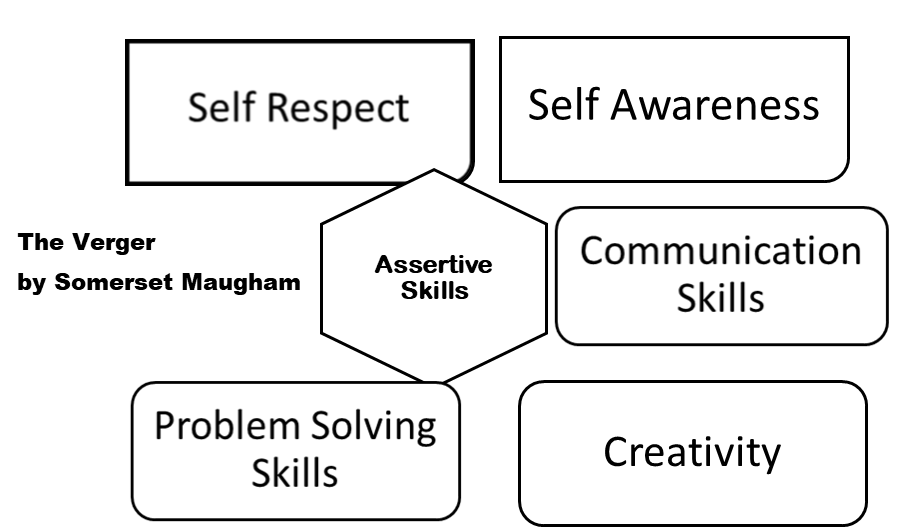
Assertive Skills
1. Assertive skills Chapter 4 : The Verger Writer : Somerset Maugham
Hint : assertive skills, Verger, Vicar, Quit job
Introduction
This question is taken from the section 'Assertive skills'. The story connecting assertive skills is 'The Verger' by Somerset Maugham.
Learning Skills
2. Learning skills Chapter 5 : Three Questions Writer : Leo Tolstoy
Hint : Learning, King, Hermit, Three questions, Knowledge, Know
Introduction
This question is taken from the section 'Learning skills'. The story connecting learning skills is 'Three Questions' by Leo Tolstoy.

Adaptability Skills
3. Adaptability skills Chapter 8: Senor Payroll Writer : William E. Barrett
Hint : Adapt, Change job, Strokers, Human relations, Self respect, Change, Alter, Junior engineers, gas plant, start, wage, conflicts
Introduction
This question is taken from the section 'Adaptability skills'. The story connecting adaptability skills is 'Senor Payroll' by William E. Barrett.

Non Verbal Communication Skills
4. Non-verbal Communication skills Chapter 9 : A Real Good Smile Writer : Bill Naughton
Hint : Boy, Billy, Locomotive shed, Alf Agar, job seekers, Action, Face, Speech, Eyes, Communication, Words - Body Language
Introduction
This question is taken from the section 'Non Verbal Communication skills'. The story connecting non verbal communication skills is 'A Real Good Smile’ is Bill Naughton.

Long question answers:
Assertive Skills
1. Assertive skills Chapter 4 : The Verger Writer : Somerset Maugham
Hint : assertive skills, Verger, Vicar, Quit job
Introduction
This question is taken from the section 'Assertive skills'. The story connecting assertive skills is 'The Verger' by Somerset Maugham.
Learning Skills
2. Learning skills Chapter 5 : Three Questions Writer : Leo Tolstoy
Hint : Learning, King, Hermit, Three questions, Knowledge, Know
Introduction
This question is taken from the section 'Learning skills'. The story connecting learning skills is 'Three Questions' by Leo Tolstoy.
In Leo Tolstoy’s story "The Three Questions", a King seeks the answers to three vital questions to rule his country well. His journey teaches us why it is important to keep updating our knowledge and skills throughout life.
The main insights in the story includes:
1. Be humble enough to learn
Even though he is a King, he admits he does not have all the answers. To update our skills, we must first realise where we are lacking. If we believe we already know everything, we stop growing. Learning begins with the humility to say, "I need to improve."
2. Be persistent in finding the truth
When the King is not satisfied with the advice he receives, he does not give up. He travels to find a wise hermit. This shows that updating your knowledge requires effort. We must be active in seeking out the best teachers and information.
3. Learn through practical work
The King does not just listen to theories; he rolls up his sleeves and digs the soil for the hermit. This teaches us that the best way to update our skills is through doing. Hard work and practice help us understand things more deeply than words alone.
4. Develop your character
The King learns to forgive a man who wanted to kill him. By doing this, he turns an enemy into a friend. This shows that updating our knowledge is not just about facts; it is also about improving our behaviour and how we treat others.
Conclusion
The King learns that the most important time is now, the most important person is the one you are with, and the most important task is to do good. By constantly learning and updating ourselves, we become better at handling life’s challenges.
Adaptability Skills
3. Adaptability skills Chapter 8: Senor Payroll Writer : William E. Barrett
Hint : Adapt, Change job, Strokers, Human relations, Self respect, Change, Alter, Junior engineers, gas plant, start, wage, conflicts
Introduction
This question is taken from the section 'Adaptability skills'. The story connecting adaptability skills is 'Senor Payroll' by William E. Barrett.
In William E. Barrett’s short story "
Advantages of Changing Jobs Frequently
In the story, the primary advantage of "changing jobs"—or the stokers’ cycle of resigning—was leverage and immediate gain. By resigning, the stokers forced the company to pay their full wages immediately rather than making them wait for the official payday. This frequent turnover highlighted their indispensability; as "aristocrats" of the workforce who performed Herculean labour in fierce heat, the company could not afford to lose them. Their willingness to leave demonstrated adaptability and risk-taking, eventually forcing the management to modify its administrative rules to suit the workers’ needs. In a modern context, this mirrors how moving between roles can lead to better terms and a higher market value.
Disadvantages of Changing Jobs Frequently
However, the story also illustrates significant disadvantages. The constant resigning and re-hiring under different names—like Villa, Diaz, and Bolivar—created bureaucratic chaos and instability for the workers. This behaviour can lead to a lack of long-term security and professional continuity. For the management, frequent turnover is a "great nuisance" that disrupts organizational objectives and creates a climate of tension and mistrust. Without the intervention of the junior engineers who acted as mediators, this cycle of job-changing might have led to a permanent loss of employment for the workers and a loss of skilled labour for the company.
Ultimately, "Señor Payroll" suggests that while frequent job changes can be a tool for asserting one's rights and achieving immediate needs, true success requires adaptability from both sides. When management finally understood the workers' problems and relaxed their rules, the need for deceptive job-hopping vanished, leading to a more stable and harmonious workplace.
Non Verbal Communication Skills
4. Non-verbal Communication skills Chapter 9 : A Real Good Smile Writer : Bill Naughton
Hint : Boy, Billy, Locomotive shed, Alf Agar, job seekers, Action, Face, Speech, Eyes, Communication, Words - Body Language
Introduction
This question is taken from the section 'Non Verbal Communication skills'. The story connecting non verbal communication skills is 'A Real Good Smile’ is Bill Naughton.


