Monday, February 3, 2025

SEM 4 BKS NOTES


Notes with Audio 

Audio by Cadet Sejal Mishra

Six Treasures:-


1. Shama (Inner Tranquility of mind)

2. Dama (Alignment between mind and senses)

3. Uparati (Interest to do work)

4. Titiksha (Forbearance)

5. Vairagya (Detachment)

6. Viveka (Conscience)


A) Six Treasures (Shat-Sampatti)


1. Shama (Inner Tranquility of Mind)


  • Control over thoughts and emotions, leading to inner peace.


2. Dama (Alignment Between Mind and Senses)


  • Controlling the senses to prevent distractions and maintain focus.


3. Uparati (Detachment from Distractions)


  • Avoiding unnecessary worldly involvement to concentrate on duties.


4. Titksha (Forbearance)


  • The ability to tolerate difficulties without frustration or complaints.


5. Vairagya (Detachment from Material Desires)


  • Not being overly attached to material pleasures or possessions.


6. Viveka (Conscience or Discrimination)


  • The wisdom to differentiate between right and wrong.

  Six Enemies :-


1. Kama (Desire / Lust)

2. Krodha (Anger)

3. Lobha (Greed)

4. Moha (Attachment)

5. Mada (Ego)

6. Matsarya (Jealousy)


Six Enemies (Shadripu - Internal Weaknesses)


1. Kama (Desire / Lust)


  • Excessive longing for material or sensual pleasures.


2. Krodha (Anger)


  • Uncontrolled anger leading to destruction and negativity.


3. Lobha (Greed)


  • The never-ending craving for wealth and possessions.


4. Moha (Attachment)


  • Excessive attachment that clouds judgment and wisdom.


5. Mada (Ego or Arrogance)


  • Overconfidence and pride that lead to downfall.


6. Matsarya (Jealousy)


  • Feeling envious of others’ success or possessions.

Chief characteristics features of Dharma and eight major types:


Characteristics of Dharma:

_______________________


1. Dhruti (Patience)

2. Kshama (Forgiveness)

3. Dama (Self-control)

4. Asteya (Honesty)

5. Shaucha (Sanctity)

6. Indriyanigraha (Control of Senses)

7. Dhi (Reason)

8. Vidya (Knowledge or Learning)

9. Satyam (Truth)

10. Akrodh (Void of Anger)


Chief Characteristics of Dharma

___________________________


1. Dhruti (Patience)


  • The ability to remain calm and composed in tough situations.


2. Kshama (Forgiveness)


  • Letting go of grudges and being compassionate towards others.


3. Dama (Self-Control)


  • Controlling desires and emotions to stay disciplined.


4. Asteya (Honesty and Non-Stealing)


  • Not taking what does not belong to oneself, living truthfully.


5. Shaucha (Sanctity and Cleanliness)


  • Maintaining purity in thoughts, speech, and actions.


6. Indriyanigraha (Control of Senses)


  • Mastery over senses to prevent distractions and temptations.


7. Dhi (Reason and Intelligence)


  • Using wisdom and intellect to make the right decisions.


8. Vidya (knowledge or learning)


  • Knowledge or wisdom that liberates. It encompasses not only intellectual understanding but also spiritual insight.


9. Satyam (truth) 


  • Truthfulness or authenticity. It involves being honest with oneself and others, and aligning one's words and actions with reality.


10. Akrodh (void of anger)


  •  Freedom from anger or non-irritability. It represents emotional balance, patience, and the ability to manage one's emotions.


Types of Dharma:


1. Swadharma (Duty to Self)

2. Parivarik Dharma (Duty of Family)

3. Samaj Dharma (Duty for Society)

4. Rashtra Dharma (Duty for the State)

5. Samsthi Dharma (Duty for Community)

6. Yuga Dharma (Duty for Contemporary Time)

7. Apad Dharma (Duty at the Time of Adversity)

8. Rutam (Duty to Natural Order)


Types of Dharma

_________________


1. Swadharma (Duty to Self)


  • Duty to oneself; following one's inherent nature, values, and principles.


2. Parivarik Dharma (Duty of Family)


  • Duty towards family; fulfilling responsibilities and obligations towards loved ones.


3. Samaj Dharma (Duty for Society)


  • Duty towards society; contributing to the well-being and harmony of the community.


4. Rashtra Dharma (Duty for the State)


  • Duty towards the nation; upholding national values, laws, and interests.


5. Samsthi Dharma (Duty for the Community)


  • Duty towards the community; working for the collective good and prosperity.


6. Yuga Dharma (Duty for Contemporary Time)


  • Duty according to the era; adapting to changing times and circumstances while upholding eternal values.


7. Apad Dharma (Duty at the Time of Adversity)


  • Duty during adversity; responding to crises and challenges with courage, resilience, and wisdom.


8. Rutam (Duty to Natural Order)


  • Duty to the natural order; living in harmony with nature, respecting its laws, and preserving the balance of the ecosystem.

SLOKA 1.

नार्यभिः को न संस्कारः सिंहस्य क्रियते वने।

विक्रमाजितराजस्य स्वयमेव मृगेन्द्रता॥


  • No baptism or ritual is performed for a lion in the forest After conquering the kingdom by his prowess he himself became a lion.


विद्या विवादाय धनं मदाय शक्तिः परेषां परिपीडनाय।

खलस्य साधोः विपरीतमेतद् ज्ञानाय दानाय च रक्षणाय॥


  • Knowledge is for quarreling, wealth for intoxication, and power for oppressing others. This is the opposite of the wicked and the saint, for knowledge, for charity and for protection.


अतितृष्णा न कर्तव्या तृष्णा नैव परित्यजेत।

शनैः शनैः शोचको भुक्त्वा स्वयं विनष्टीमृजित


  • One should not become excessively thirsty nor should one give up thirst One should gradually enjoy the wealth earned by oneself.


साहित्य-संगीत-कला-विहीनः साक्षात्पशुः पुच्छविषाणहीनः।

तृणं न खादन्नपि जीवमानः तद्भागधेयं परमं पशूनाम्॥


  • Without literature, music and art, he is like an animal without a tail or horn. Even if he lives without eating grass, his share is the supreme animal food.


सुखस्य मूलं धर्मः। धर्मस्य मूलं अर्थः।

अर्थस्य मूलं राज्यं। राजस्य मूलं इन्द्रिय-निग्रहः।

इन्द्रिय-निग्रहस्य मूलं विनयः। विनयस्य मूलं वृद्धोपसेवा॥

वृद्धोपसेवया विज्ञानं। विज्ञानेन आत्मनं जियत।

संपदितात्मा जितात्मा भवति। जितात्मा सर्वार्थं संयुज्यते॥


  • The root of happiness is religion. The root of religion is meaning. The root of wealth is the kingdom, and the root of the kingdom is conquest of the senses. The root of conquest of the senses is humility. The root of humility is to serve the elderly. By serving the elderly, one should acquire knowledge and knowledge. The acquired soul becomes the conquered soul. The conquered soul should be united with all meanings.

Wednesday, January 29, 2025

Tips for Exam- Sem II


Skills Chart


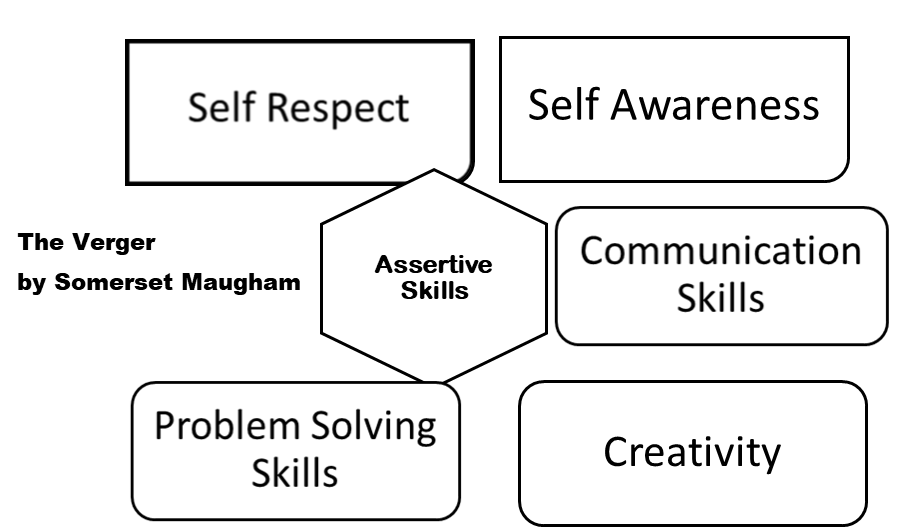
Assertive Skills

1. Assertive skills  
Chapter 4 : The Verger 
Writer : Somerset Maugham

Hint : assertive skills, Verger, Vicar, Quit job

Introduction 

This question is taken from the section 'Assertive skills'. The story connecting assertive skills is 'The Verger' by Somerset Maugham.


Learning Skills

2. Learning skills  
Chapter 5 : Three Questions 
Writer : Leo Tolstoy

Hint : Learning, King, Hermit, Three questions, Knowledge, Know

Introduction 

This question is taken from the section 'Learning skills'. The story connecting learning skills is 'Three Questions' by Leo Tolstoy.


Adaptability Skills

3. Adaptability skills  
Chapter 8: Senor Payroll 
Writer : William E. Barrett

Hint : Adapt, Change job, Strokers, Human relations, Self respect, Change, Alter, Junior engineers, gas plant, start, wage, conflicts

Introduction 

This question is taken from the section 'Adaptability skills'. The story connecting adaptability skills is 'Senor Payroll' by William E. Barrett.


Non Verbal Communication Skills

4. Non-verbal Communication skills  
Chapter 9 : A Real Good Smile 
Writer : Bill Naughton

Hint : Boy, Billy, Locomotive shed, Alf Agar, job seekers, Action, Face, Speech, Eyes, Communication, Words - Body Language 

Introduction 

This question is taken from the section 'Non Verbal Communication  skills'. The story connecting non verbal communication skills is 'A Real Good Smile’ is Bill Naughton.


Long question answers:

 Assertive Skills

1. Assertive skills  
Chapter 4 : The Verger 
Writer : Somerset Maugham

Hint : assertive skills, Verger, Vicar, Quit job

Introduction 

This question is taken from the section 'Assertive skills'. The story connecting assertive skills is 'The Verger' by Somerset Maugham.


In the short story "The Verger" by Somerset Maugham, the main character, Albert Edward Foreman, shows us how being assertive can lead to great success. Assertiveness means standing up for yourself and being honest about what you can and cannot do.

For sixteen years, Albert worked happily as a verger at a church. However, a new vicar arrived and discovered that Albert could not read or write. The vicar gave him an ultimatum: learn to read in three months or lose his job.

At this moment, Albert had two choices that would have been bad for him. He could have been submissive by crying or begging to keep his job. He could also have been aggressive by getting angry. Instead, Albert chose to be assertive. He calmly and confidently told the vicar that he was too old to learn new tricks and that he would rather leave his job than change who he was. This shows he had great self-respect.

After losing his job, Albert did not give up. While walking down the street, he wanted a cigarette but could not find a shop. He used his confidence to take a risk and opened his own tobacco shop. Because he was hardworking and confident, his business grew. Eventually, he owned many shops and became a very wealthy man.

At the end of the story, a bank manager is shocked to learn that such a successful man cannot read. Albert simply smiles and says that if he had learned to read, he would still be a poor verger.

Albert’s life teaches us that we do not need to please everyone to be successful. By being assertive, knowing our strengths, and refusing to be mistreated, we can turn a difficult situation into a big achievement.

Learning Skills

2. Learning skills  
Chapter 5 : Three Questions 
Writer : Leo Tolstoy

Hint : Learning, King, Hermit, Three questions, Knowledge, Know

Introduction 

This question is taken from the section 'Learning skills'. The story connecting learning skills is 'Three Questions' by Leo Tolstoy.


In Leo Tolstoy’s story "The Three Questions", King seeks the answers to three vital questions to rule his country well. His journey teaches us why it is important to keep updating our knowledge and skills throughout life.

The main insights in the story includes:

1. Be humble enough to learn
Even though he is a King, he admits he does not have all the answers. To update our skills, we must first realise where we are lacking. If we believe we already know everything, we stop growing. Learning begins with the humility to say, "I need to improve."
2. Be persistent in finding the truth
When the King is not satisfied with the advice he receives, he does not give up. He travels to find a wise hermit. This shows that updating your knowledge requires effort. We must be active in seeking out the best teachers and information.
3. Learn through practical work
The King does not just listen to theories; he rolls up his sleeves and digs the soil for the hermit. This teaches us that the best way to update our skills is through doing. Hard work and practice help us understand things more deeply than words alone.
4. Develop your character
The King learns to forgive a man who wanted to kill him. By doing this, he turns an enemy into a friend. This shows that updating our knowledge is not just about facts; it is also about improving our behaviour and how we treat others.
Conclusion
The King learns that the most important time is now, the most important person is the one you are with, and the most important task is to do good. By constantly learning and updating ourselves, we become better at handling life’s challenges.

Adaptability Skills

3. Adaptability skills  
Chapter 8: Senor Payroll 
Writer : William E. Barrett

Hint : Adapt, Change job, Strokers, Human relations, Self respect, Change, Alter, Junior engineers, gas plant, start, wage, conflicts

Introduction 

This question is taken from the section 'Adaptability skills'. The story connecting adaptability skills is 'Senor Payroll' by William E. Barrett.


In William E. Barrett’s short story "

Señor Payroll
," the frequent cycle of resigning and rejoining by the Mexican stokers serves as a powerful metaphor for the advantages and disadvantages of changing jobs. While the workers’ behaviour was driven by a need to circumvent rigid payroll rules, their actions highlight how job mobility can be used as a strategic tool for survival and leverage.
Advantages of Changing Jobs Frequently
In the story, the primary advantage of "changing jobs"—or the stokers’ cycle of resigning—was leverage and immediate gain. By resigning, the stokers forced the company to pay their full wages immediately rather than making them wait for the official payday. This frequent turnover highlighted their indispensability; as "aristocrats" of the workforce who performed Herculean labour in fierce heat, the company could not afford to lose them. Their willingness to leave demonstrated adaptability and risk-taking, eventually forcing the management to modify its administrative rules to suit the workers’ needs. In a modern context, this mirrors how moving between roles can lead to better terms and a higher market value.
Disadvantages of Changing Jobs Frequently
However, the story also illustrates significant disadvantages. The constant resigning and re-hiring under different names—like Villa, Diaz, and Bolivar—created bureaucratic chaos and instability for the workers. This behaviour can lead to a lack of long-term security and professional continuity. For the management, frequent turnover is a "great nuisance" that disrupts organizational objectives and creates a climate of tension and mistrust. Without the intervention of the junior engineers who acted as mediators, this cycle of job-changing might have led to a permanent loss of employment for the workers and a loss of skilled labour for the company.
Ultimately, "Señor Payroll" suggests that while frequent job changes can be a tool for asserting one's rights and achieving immediate needs, true success requires adaptability from both sides. When management finally understood the workers' problems and relaxed their rules, the need for deceptive job-hopping vanished, leading to a more stable and harmonious workplace.


Non Verbal Communication Skills

4. Non-verbal Communication skills  
Chapter 9 : A Real Good Smile 
Writer : Bill Naughton

Hint : Boy, Billy, Locomotive shed, Alf Agar, job seekers, Action, Face, Speech, Eyes, Communication, Words - Body Language 

Introduction 

This question is taken from the section 'Non Verbal Communication  skills'. The story connecting non verbal communication skills is 'A Real Good Smile’ is Bill Naughton.


Albert Mehrabian’s communication model points on the varying impact of words, tone of voice, and  body language in conveying feelings and attitudes. According to the theory, a staggering 93% of meaning is conveyed through non-verbal cues. In Bill Naughton’s "A Real Good Smile," the protagonist, Billy, discovers that while these statistics hold weight, the "visual" and "vocal" elements of communication are only effective when they are rooted in genuine emotion.
The story highlights Mehrabian’s claim that 55% of communication is visual through Billy’s obsession with his facial expression. Billy is taught that a "real good smile" is his most valuable currency. When he faces Mr. Bidwell, his practiced, literal words fail him, yet his physical presence—and eventually his raw, honest reaction—conveys more than his rehearsed speech ever could. The visual element of the smile acts as a bridge; it signals reliability and character, communicating a "message" of competence that words alone cannot prove.


Vocal elements (38%) also play a critical role in revealing social and emotional truths. Throughout the story, the pitch and speed of Billy’s voice fluctuate based on his confidence. When he is nervous, his mumbling reveals his low social standing and anxiety. Conversely, his neighbor Alf uses a controlled, authoritative tone to demonstrate mastery. This aligns with Mehrabian’s theory: the way Billy speaks reveals his vulnerability, proving that "how" something is said is often more informative than "what" is said.
However, the story’s conclusion challenges the idea that these skills can be purely mechanical. While Alf tries to teach Billy to "cultivate" a smile as a technical skill, Billy only succeeds when he drops the act. His eventual success with Mr. Bidwell comes from a moment of authentic defiance and honesty. This suggests that while non-verbal communication is dominant, it cannot be easily faked. A "real good smile" requires internal authenticity. Ultimately, Naughton’s narrative suggests that Mehrabian’s 93% is not just a technical breakdown to be mastered, but a reflection of a person's true, unvarnished self.


Monday, December 23, 2024

My Grandmother’s House


1. What is the full name of Kamala Das?

a. Kamala Suraiyya Das

2. When was Kamala Das born?

a. 1934

3. Name the poem written by Kamala Das?

a. My Grandmother’s House

4. Kamala Das was a/an ________.

a. Indian English Poet

5. Kamala Das was called ________.

a. The mother of Modern English Indian Poetry

6. Who acclaimed Kamala Das as ‘The mother of Modern English Indian Poetry’?

a. The Times

7. In which year did The Times, acclaim Kamala Das as ‘The mother of Modern English Indian Poetry’?

a. 2009

8. What are the key aspects/ elements in the poetry of Kamala Das? 

            a. Confessional elements and women’s issues (female sexuality) 

9. What are the themes found in the poetry of Kamala Das?

a. Hypocrisy of marital life and constraints imposed by Patriarchal Society

10. When the Grandmother died, the house withdrew into _____.

a. Silence

11. What is the tone of the poem, ‘My Grandmother’s House’?

a. Sense of discontent at loss of love 

12. What does the final line in the poem, ‘My Grandmother’s House’ indicate?

a. Unhappiness and disillusioned 

13. Whose death is the poet lamenting in the poem, ‘My Grandmother’s House’?

a. Her grandmother

14. What is the poet describing in the poem, ‘My Grandmother’s House’?

a. The poet’s Grandmother’s house

15. When the grandmother died, the house withdrew into _____.

a. Silence 

16. The windows are portrayed as having ____

a. Eyes (Peer through blind eyes of windows)

17. The air in the lost house is described as ____

a. Frozen (Just listen to the frozen air)

18. The poet was proud of ______.

a. Living in such a house. (grandmother’s house)

19. The house is portrayed as a place of ____

a. Love

20. The house became cold and dark when _____

a. The grandmother passed away

21. The predominant sense conveyed by the poem is one of ___

a. Loss

22. What is described as lying behind the bedroom door as a brooding dog?

a. Memories

23. What imagery is used to establish the tone of the poem?

a. Nature imagery (cold moon, frozen air) and Animal imagery (snakes and brooding dog)

24. Whom does the poet address as darling?

a. The readers (implying an intimate relationship) or the speaker’s husband

25. What does the word brood mean in the poem, ‘My Grandmother’s House’?

a. To think deeply about something that makes one unhappy

26. What does the poet want to receive at least in small exchange, as in the poem, ‘My Grandmother’s House’?

a. Love

27. Or in wild despair, pick an armful of ______.

a. Darkness

28. I lived in such a house and was _____ and ____.

a. Proud and loved

29. Pick an armful of darkness to bring it here to lie behind my ____

a. Bedroom door

30. In which year did the poet Kamala Das breathe her last?

a. 2009

Sunday, December 15, 2024

Sem 6 Dialogue Writing


Click here for SEM 6MCQ and Grammar Practice


3. DIALOGUE WRITING- SAMPLE

1.                 Draft a formal dialogue between Gita Naidu and Madhu Kumar who meet at the post office. They stay in the same locality, but do not know each other very well. It is three o’clock in the afternoon. 

Answer 

1. Character’s name : Gita Naidu and Madhu Kumar

2. Conversation Type : Formal conversation

3. Day and date : December 9, 2022, Wednesday

4. Time : 3 o’ clock in the afternoon

5. Venue : At the post office

6. Topic /Situation : Greeting each other

 Madhu Kumar :  Good afternoon, Mrs. Naidu.

 Gita Naidu : Good afternoon, Mr. Kumar. How are you?

 Madhu Kumar : I am very well, thank you. Hope you are also doing great. It’s being a long time that we meet.

 Gita Naidu : I am fine, thank you. Very true, we meet after a long time.  If I am guessing right, we meet last month at the school for the annual function of kids. By the way once again congratulations for your son’s achievement in national chess competition. He is a very sweet child.

Madhu Kumar : Thank you so much ma’am. Indeed we met last month. I saw the Carnatic dance by your daughter, she was very elegant in her performance. Is she doing some classes for the same?

Gita Naidu : Thank you for your kind words, Mr. Kumar. Will surely convey your compliment to Shrusti. She is practising her art for the last 5 years. She is very passionate with her performance. By the way, what made you visit the post office? I am here to send some photos of Shrusti’s performance to her grandparents.

Madhu Kumar : Okay. Your parents would feel proud looking at the pictures. I came to buy some stamps and send this letter of application for the Chess competition to be held in Delhi next month. Along with the online form, they have mentioned on the website that they require hard copy of the form as well. Have a nice day, Mrs. Naidu.

Gita Naidu : Thank you and you too enjoy your day. Bye! 

Madhu Kumar :  Good bye. 


2.                 Annie is at the birthday party of a friend, Smita. She has not met Smita’s father, so she introduces herself and tells him a little about herself.

Answer 

1. Character’s name : Annie, Smita, Smita’s father 

2. Conversation Type : Semi formal conversation 

3. Date: 17th December 2024

4.Time : 10 o’ clock in the morning 

5. Venue : At Smita’s home  

6. Event: Smita's Birthday Party

7. Topic/Situation: Annie Introducing herself to Smita's father


--------------------------

Annie

: Hello Smita. Many many happy returns of the day to you. 

Smita

 : Hey Annie. Thank you so much for coming. You look lovely.

Annie

: Thank you dear. Thank you for inviting me. You have a beautiful house. And yes this dress, remember we bought 2 dresses together from the mall last month. This is one of them.

Smita

: Oh yes! I remember the dress now. Talking about the house, this construction is my father’s design. He is an architect and is into designing homes. Hey! You yourself is a very good artist, I have seen your sketch works. I think you should meet my father, you will get more inspiration to draw and also who knows, you might get some more insight to plan your future with your skills. 

Annie

: Very true Smita. Where is your father? Since I have never met your parents, I think I should be taking this opportunity to meet them.

Smita

: Come this way.  

(Reaching the space where her father was standing) 

Here! Meet my father. 

Father

: This is my friend, Annie, who loves art. I think you could help her to seek guidance related to how she can channel her skills to better use. 

Annie

: Annie, he is my father, Mr. Shamkumar and the beautiful lady sitting next to him is Mrs. Shradha, my mother.

Smita’s father

: Hello Annie. It’s a pleasure to finally have met you.  Smita keeps talking about you a lot. Glad that you both have bonded pretty well. 

Annie

: Hello Uncle. Thank you so much for your kind words. She is just over reacting to my work. I am still learning, and just keep sketching when I get some time.

Smita’s father

: That is indeed a great way to use your free time, Annie. So tell me Annie what sort of artwork do you prefer? And what is the inspiration behind your interest in artwork?

Annie

: Uncle, my mother is an art teacher. From her I used to learn. I prefer architectural drawings surrounding more natural elements. I visualise living in a multi- utility space, surrounded by lots of trees, mountains near the sea.

Smita’s father

: That is a really stunning concept Annie. I would love to see your artwork. Maybe we can work on some good ideas. Do enjoy the party dear. And hope to see you often. Smita’s mother is also into sketching, we all plan something productive.

Annie

: Surely I will stay connected with both of you. 

Thank you so much for guiding me right.


Sem 5 AEC

  T.Y.B.COM SEM V SEC SKILL ENHANCEMENT COURSE ADVANCED COMMUNICATION SKILLS IN ENGLISH  UNIT1 TEXTBOOK - ASPIRATIONS  Section A: One-Word S...